
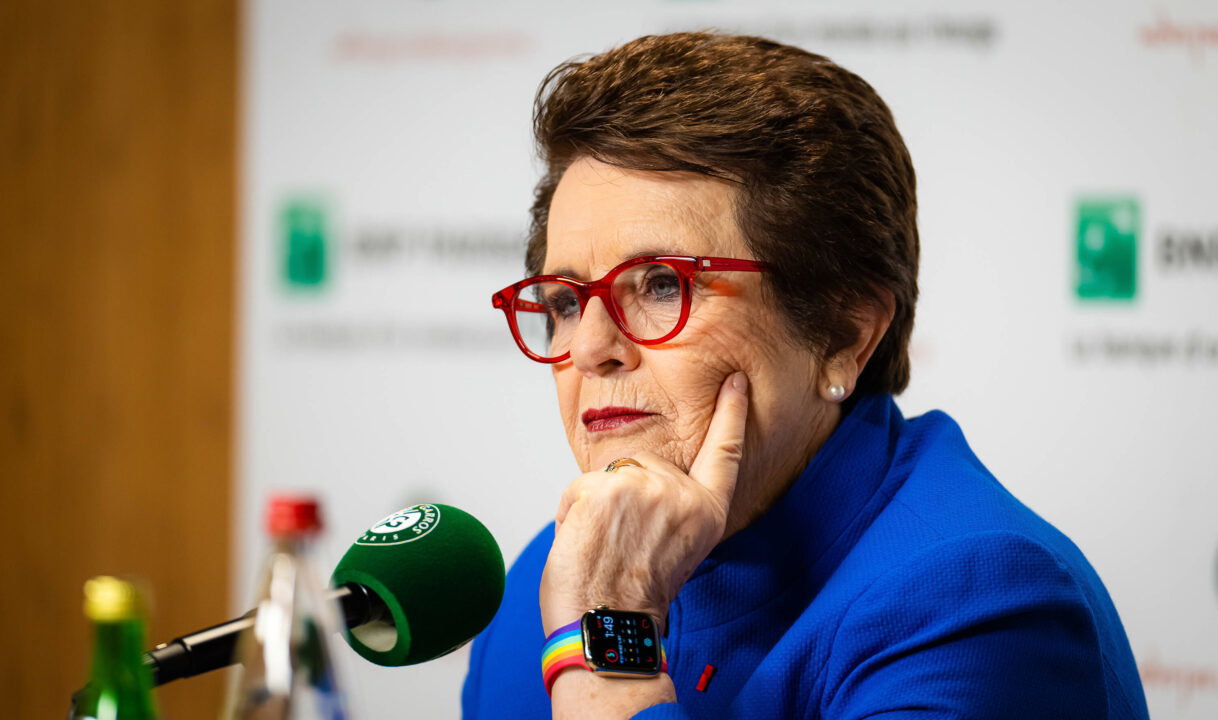
While Billie Jean King fought for equal pay and better opportunities for WTA players, Anita DeFrantz did the same in the field of the Olympics, ensuring that women had a role to play in the prestigious event, both on the field as athletes and off the field as part of the administration. Therefore, it was no surprise that both were kindred spirits, and King was among the first to send an emotional message upon the former IOC vice-president’s passing at the age of 74 after a four-year-long cancer battle.
“Anita DeFrantz was a change maker in every sense of the word,” said King on X. “Not only was she the first Black American and the first American woman elected to the IOC, but she also was the first woman to serve as an IOC vice president. An Olympic bronze medalist in rowing, Anita was a friend who was great at asking questions and listening. We are all indebted to her for advocating for equality and leadership for women in sports. Sending our condolences to her family and friends.”
DeFrantz had the somber diagnosis of gastric cancer back in 2021. The American underwent surgical procedures, one of which involved removing her stomach, which understandably left her in ill health for the last few years. The ailment did not stop her from doing her duties, which included a plane ride to Greece to cast her vote at an IOC meeting that elected its first female president, Kirsty Coventry.
Even during her days as an athlete, DeFrantz was not hesitant to speak out against the norm. Back at the 1980 Olympics, when the US team boycotted the event due to geopolitical tensions, DeFrantz was one of the few voices who challenged the decision, arguing that athletes had the right to determine which events to take part in, even taking her case to court. This was after she had won a bronze medal in rowing at the 1976 Games, which were held in Montreal.
From being an athlete in 1976 and an activist in 1980, DeFrantz made her initial foray into sports administration in 1984, serving on the hosting committee for the 1984 Los Angeles Olympics. Three years later, in 1986, she became a member of the International Olympic Committee, leading the charge for increased women’s participation at the Olympics, eventually becoming the IOC vice-president in 1997.
DeFrantz and King often crossed paths at conventions and meetings, with both sharing numerous prestigious accolades. The most notable one was when DeFrantz was awarded the Billie Jean King Contribution Award in 1996 by the Women’s Sports Foundation, an organization founded by the former World No. 1 herself.
The two women also shared the stage when they were both inducted into the International Women’s Forum Hall of Fame in 2022. Both DeFrantz and King were inducted into the American Olympic and Paralympic Hall of Fame in 2025 and 2022, respectively. King was not the only one to pen an emotional note for DeFrantz after the latter’s demise, as the IOC and the US Olympic Committee also issued heartfelt statements expressing condolences on the 74-year-old’s passing. King is known for paying tributes to activists, as the American icon paid a similar tribute when civil rights activist Dolores Huerta passed away last month.
When DeFrantz competed at the 1976 Olympics, women accounted for only 20.7 percent of all athletes, compared with a record 49 percent in Paris in 2024. DeFrantz has had a big hand in driving up the number with changes she brought in both on and off the field.
Anita DeFrantz Brought In a Lit of Changes
DeFrantz was one of the leading voices in the 90s, when the IOC decided not to allow any new sport with only male disciplines. The new ruling meant that sports federations of individual countries had to develop state-of-the-art programs for the female athletes if they wanted to be included in the Games.
Being an athlete herself, DeFrantz was one of the driving forces behind the introduction of women’s soccer and softball events at the 1996 Atlanta Games. Weightlifting, wrestling, water polo, and several other sports began to include women’s disciplines in subsequent games, largely due to DeFrantz’s constant lobbying and influence as the IOC vice-president.
Not only on the field but also off the field, DeFrantz fought to increase women’s participation in Olympic administration. In 1996, she ensured that at least 10% of executive positions in individual national federations were held by women, a benchmark that has since been well surpassed.
The last Olympics in Paris saw over 5000 female athletes participate, with 151 women’s events taking place, which accounted for 45.7 percent of the total events at the Games, a sharp rise from the numbers in the 90s and even in the early 2000s, something that will be DeFrantz’s legacy forever.